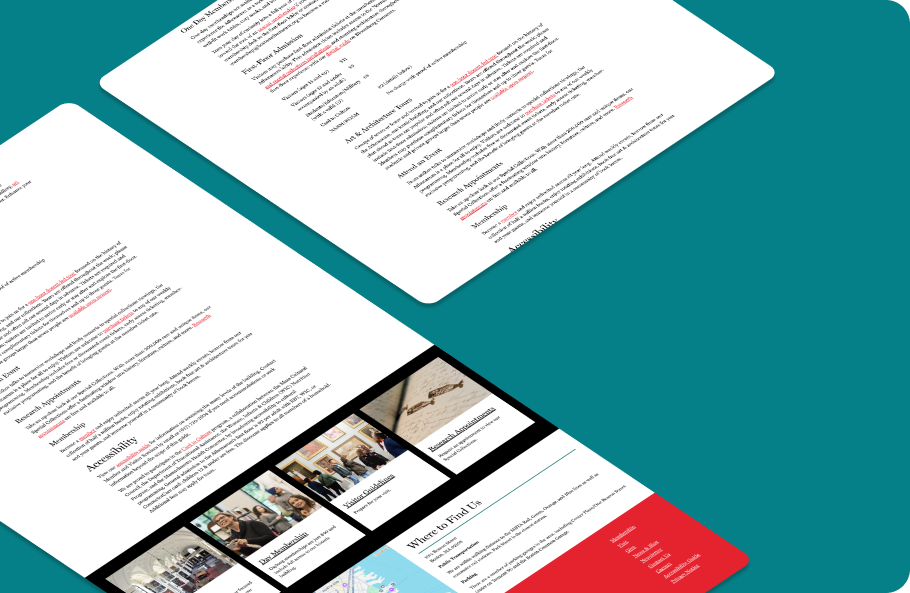
Boston Athenaeum Case Study

WordPress Design System: Incremental Modernization for the Boston Athenaeum

Project Snapshot

Industry Icon Industry
Nonprofit
Outcome
Created a scalable, brand-enforcing WordPress design system that empowered a small internal team to migrate and rebuild a 100+ page historic institution website incrementally without operational disruption.
The Challenge

Modernizing a Legacy Website Without the Risk of a Full Rebuild

The Boston Athenaeum, one of the nation’s oldest independent libraries, museums, and cultural centers, had outgrown its digital footprint. Years of ad-hoc technical updates had left the site burdened with fragmented layouts, rigid and unmaintainable page templates, and a backend content editing interface that made routine updates frustrating.

With a deep catalog of more than 100 content-rich pages and a small communications team juggling multiple institutional responsibilities, a traditional website redesign wasn’t feasible. The historic institution required a scalable solution to modernize its digital presence, adopt a newly established visual brand identity, and overhaul its editorial workflow, all without disrupting day-to-day operations or launching a high-risk, single-day cutover.

The Strategy

A Component-Driven Gutenberg Design System

Instead of recommending a costly and disruptive site overhaul, New Why engineered a phased WordPress modernization strategy built around a centralized design system.

Collaborating closely with the Boston Athenaeum’s design partner, Minelli, Inc., we translated a sophisticated new visual identity into a highly flexible library of native, reusable WordPress Gutenberg blocks and custom layout variations. Rather than executing an all-at-once content migration, we focused on building an intuitive visual page builder environment.

We developed and launched the high-priority primary landing pages first, successfully equipping the Athenaeum’s internal team with the precise component tools, layout constraints, and training required to securely migrate the remaining pages at their own operational pace.

Execution

Modular Architecture & Brand-Consistent Controls

By separating the underlying design system engineering from the front-end page migration, the Boston Athenaeum avoided the operational hazards of a traditional website launch. The final deployment established a scalable web ecosystem designed to evolve gracefully:

01Custom Gutenberg Block Library

Engineered a suite of bespoke, modular content blocks (atoms and molecules) allowing editors to build rich, visually complex layouts without touches of custom code or bloated third-party page builder plugins.

02Flexible Layout Variations

Built advanced block styles and responsive display variations, granting the communications team creative flexibility while programmatically locking in core design ratios.

03Brand-Enforcing Theme Controls

Embedded semantic style rules, typography scales, and strict color palette limitations directly into the theme architecture, ensuring every user-created page remains perfectly on-brand.

04Collaborative Migration Blueprint

Rebuilt and launched the primary traffic-driving institutional hubs while building out a modular staging framework for the remaining pages.

05Knowledge Transfer & Training

Delivered structured, hands-on administrative training to provide the internal staff with full autonomy over long-term content management and layout creation.

How We Do It

Our Approach to WordPress Development for Cultural Institutions

For historic cultural institutions and mission-driven organizations, a website redesign cannot come at the expense of daily operations or brand integrity. When internal teams manage extensive content catalogs with limited bandwidth, monolithic website rebuilds create unnecessary risk and strain.

New Why approaches enterprise WordPress projects by engineering flexible, component-driven design systems. By turning complex brand guidelines into intuitive Gutenberg block libraries, we empower internal teams to modernize their digital presence incrementally, maintain absolute visual control, and scale their websites on their own timeline.

The Outcome

Visual Modernization and Total Team Autonomy

Phased Migration Success: Successfully modernized a massive cultural institution website incrementally, eliminating the downtime, bugs, and launch-day stress of a standard site rebuild.

Editorial Independence: Shifted a small communications team from developer-dependence to total layout freedom, drastically reducing the turnaround time for publishing new pages and programming updates.

Unified Brand Integrity: Established rock-solid visual consistency across all newly migrated pages, accurately reflecting the Boston Athenaeum’s elevated brand identity across mobile and desktop environments.

Future-Proof WordPress Engineering: Replaced restrictive legacy code with an agile editing experience optimized for native Core Web Vitals performance and clean semantic crawlability.

“Great to Work With! ”

From the beginning, the New Why team was responsive, collaborative, and great to work with. They listened carefully, understood our constraints, and proposed a solution we hadn’t even considered. Instead of forcing a complete rebuild of our aging and complex site, they created a flexible design system that allowed us to modernize our website at our own pace. The result is a site that’s easier to manage, easier to grow, and far better suited to our team’s day-to-day needs.

Angie Osborn, Marketing Manager

Related Resources

Explore more insights and strategies
SERVICE

Custom WordPress Development

Explore our full range of WordPress architecture and platform engineering services built for growing organizations.
BLOG

To Sidebar, or Not to Sidebar?

A practical look at the pros and cons of website sidebars, and how to decide whether one is right for your website.

Ready to modernize your website without starting from scratch?

Let’s build a flexible WordPress design system that allows your team to upgrade your site incrementally.